On Friday, June 19, we had our day in the Supreme Court of British Columbia. After years of closed-door meetings, scripted talking points, and a fight that too many people were told was unwinnable, the question voters actually approved in 2022 was finally put to a judge.
And you showed up. Twice.
A Full House — Two Days Running
The night before the hearing, on Thursday, June 18, we held a rally. People came with signs. People came in their team gear. People came who had never been to a rally in their lives, because they understood what was at stake. And before they left, a remarkable number of them said the same thing: we'll see you in court tomorrow morning.
They meant it.
At 10 a.m. the next day, we walked into the courtroom and found nearly every seat taken — a room built to hold somewhere around 180 to 200 people, filled almost to capacity, on a Friday morning, for what was, on paper, a municipal judicial review about a swimming pool. That doesn't happen by accident — and it doesn't happen for a pool alone. You cannot manufacture a room that full. People filled it because they understand what this case is actually about: whether a vote in Vancouver means anything at all once the ballots are counted. The pool is what you can see from the street. The thing on trial is the value of their vote.
To everyone who came: thank you. The judge saw that room too.
The Room Itself
It's worth pausing on where this was heard. Our hearing was assigned to Courtroom 20 at the Vancouver Law Courts on Smithe Street — the province's high-security courtroom, a fortified room in the basement built behind bulletproof glass. It was purpose-built in 2002 for the Air India terrorism trial, and in the years since it has hosted some of the most consequential and closely watched proceedings in British Columbia, including the 2018 bail hearing and subsequent extradition fight of Huawei executive Meng Wanzhou. It is, by a wide margin, the largest courtroom in the building.
That is the stage this case was given — and the venue fit, because the stakes here were never really aquatic. A fight that looks, from the outside, like a dispute over a swimming pool was heard in the room the province reserves for its biggest cases, because at its core this is a case about the Vancouver Charter and the value of a vote.
The petition was heard by Justice Christopher J. Giaschi, appointed to the BC Supreme Court in 2018 after a career in maritime, admiralty, and transportation law. He heard a full day of argument and has reserved his decision on the main petition.
Our Case
Our counsel, Robbie Fleming, opened in the morning, and he was meticulous. This case has a lot of moving parts — a plebiscite, a Capital Plan, voter information materials, a Park Board resolution, a borrowing authority — and the central skill on display was taking something genuinely tangled and making it simple. He walked the Court through the timeline in sequence, document by document, building the story the way it actually happened.
And the story is straightforward. The question is whether borrowing authority that Vancouver voters approved for the renewal of a 50-metre aquatic facility can lawfully be spent on removing it instead.
We say it cannot — and the City's own paper trail is the proof. The Capital Plan promised a first phase "focusing on the renewal of the 50m lap pool and diving pool." The City's official, City-branded voter information package said the same thing. The VanSplash aquatic strategy pointed the same direction. Voters were never once told that "renewal" might mean a half-size, 25-metre replacement. They approved the borrowing on the understanding the City put in front of them, in writing, on its own letterhead.
He also had a gift for making a dense point land. To capture how the City and the Park Board each deflect responsibility for this — the City saying the design is the Park Board's call, the Park Board saying it doesn't control the money — Robbie turned and pointed in both directions at once: the old Bugs Bunny routine where everyone insists "he did it." The gallery laughed, and then broke into applause. A lighter moment, but the point underneath it was serious: a decision this consequential has been arranged so that no one ever has to answer for it.
The City's Case
In the afternoon, the City and Park Board put their arguments to the Court. Two things stood out.
First, the "extraneous materials" argument. The City's position is that its own Capital Plan, its own voter information package, and its own published materials — the documents it wrote, branded, and distributed to win the vote — should be set aside as supplementary background with no bearing on what voters authorized. In other words: ignore the promises we made to get your vote. It is a hard thing to stand up in a courtroom and argue that your own official materials don't count, and it did not get easier in the telling. For an argument the City had years to prepare, it was a strikingly unsophisticated one — and in the room, it came across exactly that way.
Second, the safety story — minus the evidence. A significant portion of the City's time was spent on the claim that the existing building is unsafe and must close. What was missing was any engineering report to support it. Not one. Meanwhile, the engineering reports actually before the Court — commissioned by the City itself — point the other way: the Ausenco report (February 2023) found remediation of the concrete "feasible and practical," and an independent structural engineer concluded in November 2025 that the building's structural integrity is not at risk. We were, in effect, reading the City's own reports back to it.
What This Case Is Really About
It would be easy to read all of this as a fight over a swimming pool. It isn't — and by the end of the day, that was the heart of what we argued.
The pool is the output. It's what a "yes" vote in 2022 was supposed to build. The case is about the vote itself: whether the Vancouver Charter's plebiscite and voter-assent provisions (sections 245 and 245A) mean what they say, and whether the specific materials that defined what people were voting for — the Capital Plan, the official City-branded voter package, the project as it was described and promised — carry any legal weight at all.
Because if the City can win on its "extraneous materials" theory, the precedent reaches far beyond this one building. It would mean a municipality can put a detailed, specific project in front of voters, secure their assent, borrow against it — and then deliver something materially different, waving away every promise it made along the way as supplementary background. That would reduce a Vancouver plebiscite to an expensive opinion poll the City is free to ignore.
That is what filled Courtroom 20. Not a pool. A vote — and the question of whether, in this city, a vote still means what it says.
The Pool's Closure, and Why Tuesday Matters
In the weeks before the hearing, the City posted notices at the VAC announcing that June 28, 2026 will be the facility's final day of operation — to allow for "site preparation and transition work ahead of demolition and construction." In the City's own words, the closure is part of the very construction project this case is about.
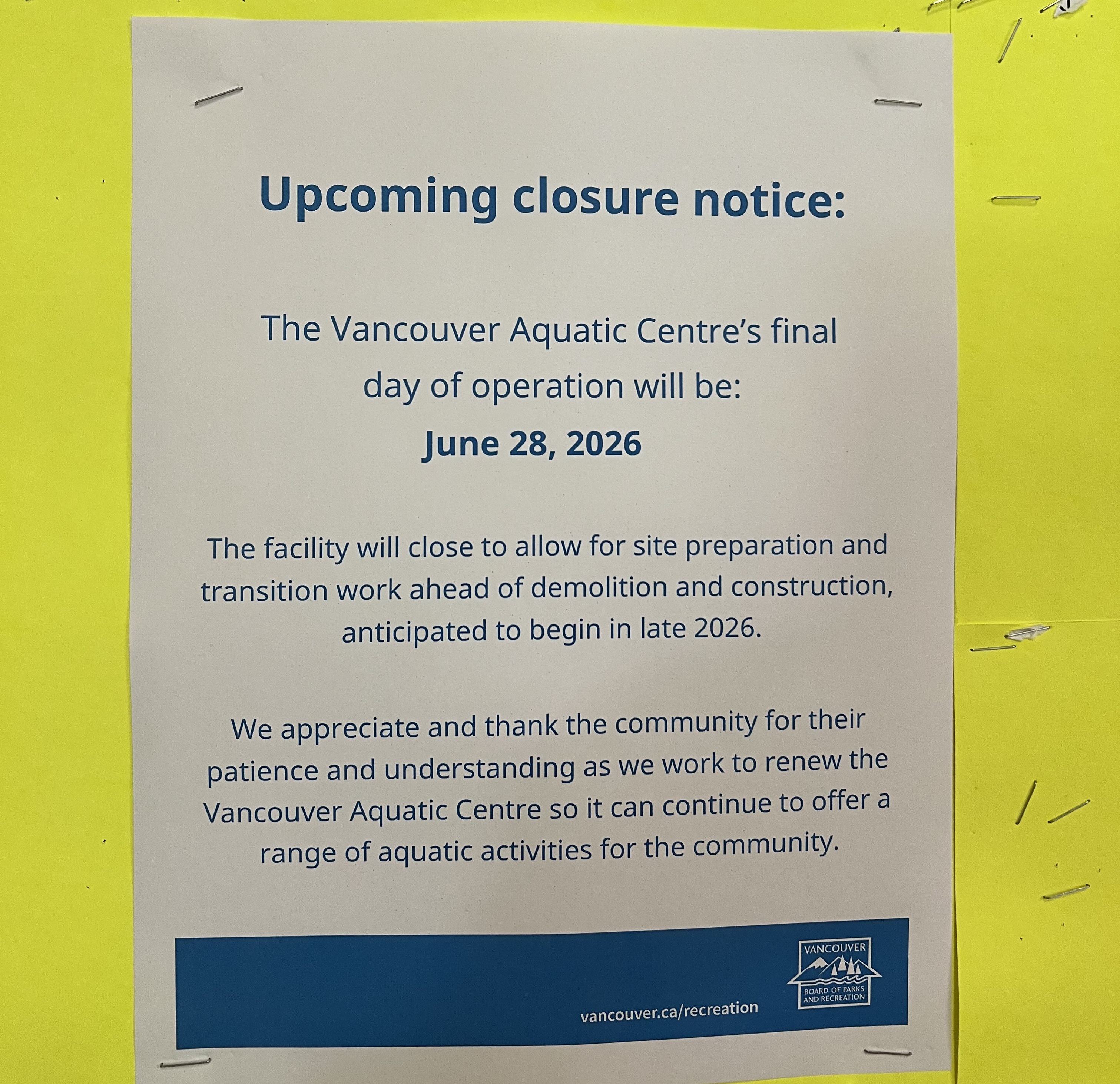
That is why, alongside our request to quash the resolution and uphold the voter mandate, we asked the Court for an interim injunction: an order keeping the pool open until this case is decided, on the specific ground that the City is closing it as a step in the project we are challenging. We can't ask the Court to stop a closure for reasons unrelated to this case — but where the City itself ties the closure to the impugned project, the Court can be asked to hold the line until it rules.
Justice Giaschi has committed to delivering his decision on that injunction question on Tuesday, June 23.
A word on expectations, because we'd rather be straight with you than spin it: this is one discrete piece of a larger case. Interim injunctions are rarely granted, and granted against a municipality more rarely still — so a win here would be significant in its own right. But the injunction ruling is separate from the main decision. A result either way on Tuesday does not determine how the Court will rule on the voter mandate itself. We'll share the outcome as soon as we have it.
What Happens Now
The main decision is reserved. That was expected, and it is normal for a case of this weight. The judge will take the time the case deserves, and so will we.
What we know is this: we put a clear, documented, honest account in front of the Court, in the largest room the province has, in front of a packed gallery of the people this decision actually affects. We asked the Court to hold the City to what it told voters in writing. That is the whole of our case, and we're proud of how it was made.
We'll write again the moment there is news to share — starting Tuesday.
For journalists: We're happy to walk you through the petition, the filed materials, and the documentary record. Counsel is not available for comment. For all other inquiries, please click here to email us.
Last Updated: June 22nd, 2026
With thanks,
Jon Girard Managing Director, PROTECTING OUR VANCOUVER AQUATIC CENTRE SOCIETY
PROTECTING OUR VANCOUVER AQUATIC CENTRE SOCIETY (S0083228) is a registered non-profit organization dedicated to democratic accountability and voter rights. The judicial review (Case No. S-263492) has been brought pursuant to the Judicial Review Procedure Act.