Community updates on the legal action challenging the Vancouver Board of Parks and Recreation and City of Vancouver’s decision to downsize the Vancouver Aquatic Centre pool from 50m to 25m.
June 5th, 2026 by Jon Girard • 5 min read
The City Filed Its Response. It Argues Your Voter Mandate Was Just a Vibe
After years of closed-door meetings, scripted talking points, and a $170-million budget, the City of Vancouver and the Park Board have finally told a judge why they were allowed to delete the 50-metre pool that voters approved.
The Response is dated June 1. The hearing is June 19. And we have to be honest with you: we expected better.
We expected a single, confident argument. Instead we got four arguments that openly contradict each other, propped up by exactly one affidavit, capped off with a falling-concrete horror story that has nothing to do with the actual case. Let's take the tour.
The Opening Flex: "We Consent to Nothing"
The Response begins with a flourish. The City "consents to the granting of the orders set out in none of the paragraphs," takes "no position on the granting of the orders set out in none of the paragraphs," and opposes everything else. Bold. Decisive. A masterclass in agreeing to absolutely nothing.
It also, in paragraph 27, informs the Court that the public plebiscite "was passed unanimously." We want to be generous here, but: roughly 47,000 Vancouverites voted no. A plebiscite cannot pass "unanimously." This is the document the City had years to prepare. It could not get the basic facts of its own vote straight.
That's the standard of care. Keep it in mind.
The Filed Response
Argument #1: "Renewal" Is Just, Like, a Feeling
The City's headline argument is that the word "renewal" doesn't really mean anything in particular. The ballot said "replacement, renewal or rehabilitation," it didn't say "50-metre pool," and therefore — the City argues with a straight face — "renewal" can involve the thing "changing, even significantly."
So under the City's theory, "renewal of the Vancouver Aquatic Centre" is roomy enough to authorize cutting the main pool in half. Which raises the obvious question: what couldn't it authorize? A parking lot? A food court? A commemorative plaque where the pool used to be? If "renewal" can mean "remove the thing you promised to renew," then a borrowing plebiscite is just an expensive opinion poll the City is free to ignore.
The City wants the word to mean everything, which is the same as making it mean nothing. Voters are not idiots. They knew what they were funding.
Argument #2: "Ignore the Promises We Made to Get Your Vote"
This one is special.
The City admits — because the paper trail makes denial impossible — that its own Capital Plan promised a ~100,000 sq ft facility with the first phase "prioritizing the renewal of the 50m lap pool and diving pool," and that its own voter information package promised to "start construction on the first phase focussing on the renewal of the 50m lap pool and diving pool."
The City's response to its own written promises? They are "extraneous materials." Irrelevant. Pay them no mind.
Let's translate. The City made specific promises to get a vote, and now that someone is holding it to those promises, it would like the Court to treat them as background noise. Imagine signing a contract and being told the parts you relied on were "extraneous." That's the City's legal theory: the fine print they wrote, advertised, and mailed out is suddenly none of your business.
Argument #3: "Fine, But We Voted to Overrule You Anyway"
Then, having spent pages insisting the plebiscite never required a 50-metre pool, the City turns around and argues — in the alternative — that even if it did, Council validly "varied" the project under Section 245(3) of the Charter on June 18, 2025.
Sit with that for a second. You only reach for a power to override the voters if you suspect the voters had a say in the first place. By pleading this argument at all, the City is quietly conceding the very thing it spent the previous ten paragraphs denying. It's the legal equivalent of "I didn't take the cookies, and besides, I was allowed to take the cookies."
And the "override" itself? It was a quarterly budget-adjustment meeting. A line item. Nobody stood up and announced they were using a special statutory power to cancel a democratic mandate. You don't get to bury the overruling of 102,000 voters in a capital-budget closeout and call it democracy.
Argument #4: Pin the Decision on the Other Guy
The City's position on the Park Board's decision is, essentially: don't blame the Park Board, it doesn't control the money — the City does. The City's position on the money is, essentially: we just funded what the Park Board approved.
So the Park Board points at the City. The City points at the Park Board. And a $170-million decision to ignore the voters floats in the space between them, owned by no one. We've been telling you for a year that this project was engineered so that nobody would ever have to answer for it. The City just filed a court document proving it.
The Evidence: One Affidavit, Mostly Marked "Confidential"
For all of this, the City filed a single affidavit. Twenty of its paragraphs are a tidy inventory of in-camera meetings and confidential memos — Exhibit A through Exhibit S — a few helpfully "redacted to remove legal advice."
Think about what that record actually is. The City's evidence that the public was properly served by this process is a stack of documents the public was never allowed to see. It is a monument to exactly the secrecy this entire case is about. We could not have assembled a better exhibit list ourselves.
Affidavit of Sarah Iocoe
The Grand Finale: The Falling-Concrete Show
When the law is against you and the facts are against you, you pound the table. The affidavit's last few paragraphs are the table-pounding: a façade that fell in 2022, pool decks closed, concrete spalling, safety netting, a building at "end-of-life," ominously destined for demolition "regardless of whether funding is in place for a replacement."
It's vivid. It's also completely beside the point — and that last line accidentally admits it.
Our petition does not ask to keep the old building open. It asks what the new building has to contain. Whether the current VAC sheds concrete has precisely nothing to do with whether the replacement must include the 50-metre pool voters paid for. You could knock the old one down tomorrow; the legal question wouldn't move an inch. The City knows this — which is why the affidavit cheerfully admits demolition is happening "regardless of funding." The safety story isn't a reason. It's set dressing, deployed to make a judge feel that anyone who questions this project wants children swimming under falling concrete.
And the structural-collapse framing doesn't survive contact with the City's own files. Spalling and envelope failures are maintenance problems, not structural ones. The City's own Ausenco report (February 2023) said remediating the existing concrete is "feasible and practical." An independent professional structural engineer concluded on November 6, 2025 that the building's structural integrity is not at risk. And here's the common-sense part: if this facility were the death trap the affidavit implies, it would already be closed. No city on earth keeps a genuinely unsafe public pool open and full of swimmers. The liability alone would end careers. The building is open because the building is standing.
See You June 19
This is the City's best shot. Four arguments that can't all be true, one affidavit built on documents nobody was allowed to read, and a fear story that answers a question we never asked.
The hearing is June 19, 2026, in the Supreme Court of British Columbia. The City will argue that your vote was a vibe. We'll argue that it was a mandate. We like our odds.
Before Then — Join Us This Saturday
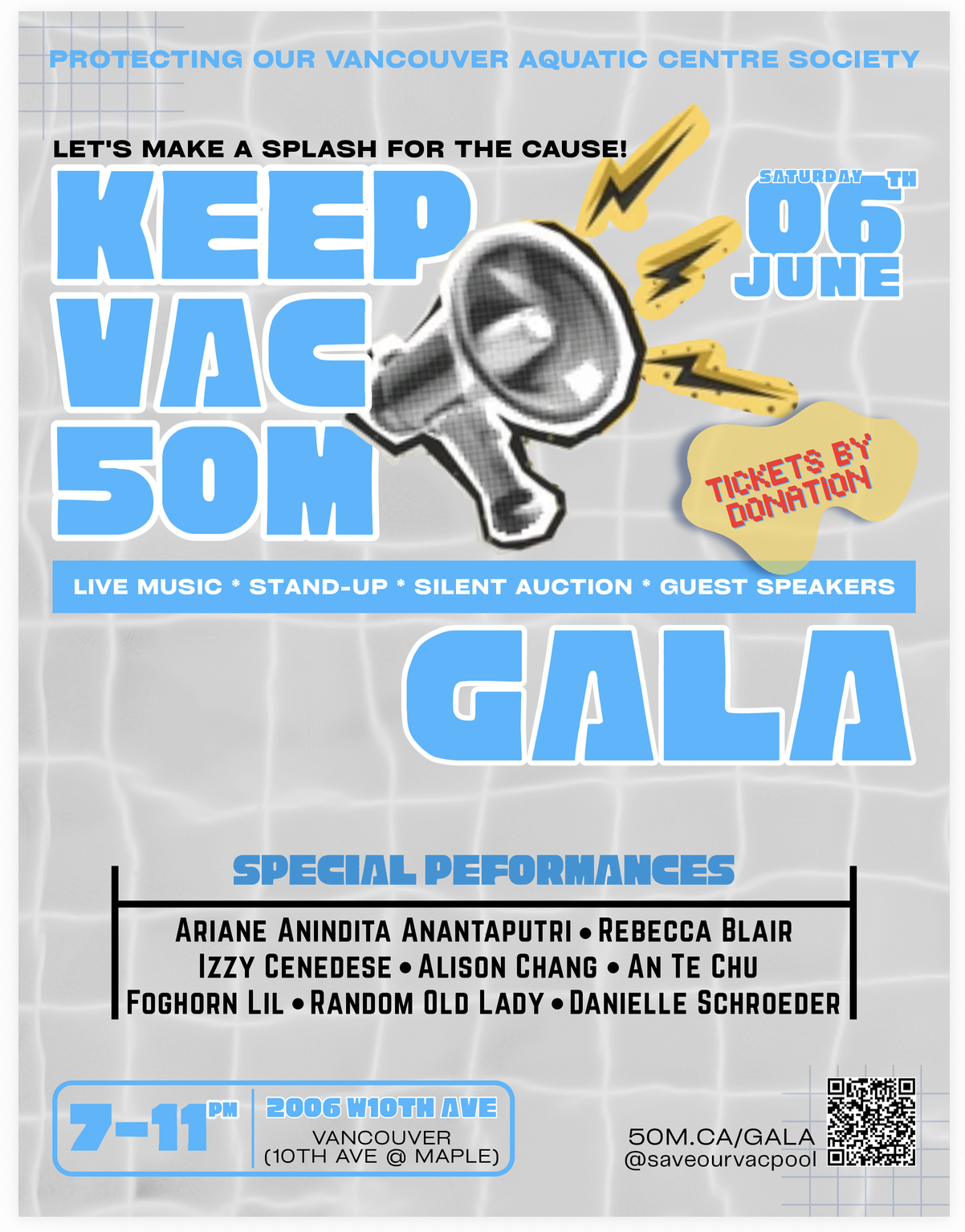
We're throwing a party, and you're invited. This Saturday, June 6th, we're hosting our gala to celebrate this community and fuel the final push to the hearing. The evening features live music, speakers, comedy, and a silent auction — a chance to stand alongside the thousands of Vancouverites who refuse to let a voter mandate be argued away as a turn of phrase.
Tickets are available now at 50m.ca/gala. Come for the cause, stay for the entertainment, and help us walk into June 19th with the wind at our backs.
For journalists: We're happy to walk you through the filed Response, the affidavit, and our supporting documentation. Click here to email us.
Last Updated: June 5th, 2026
Please subscribe to our newsletter for updates sent direct to your inbox
PODCAST
Episode 1: Understanding the Vancouver Aquatic Centre Legal Challenge